 Menu
Menu
04 November, 2023
Corporate startup collaboration
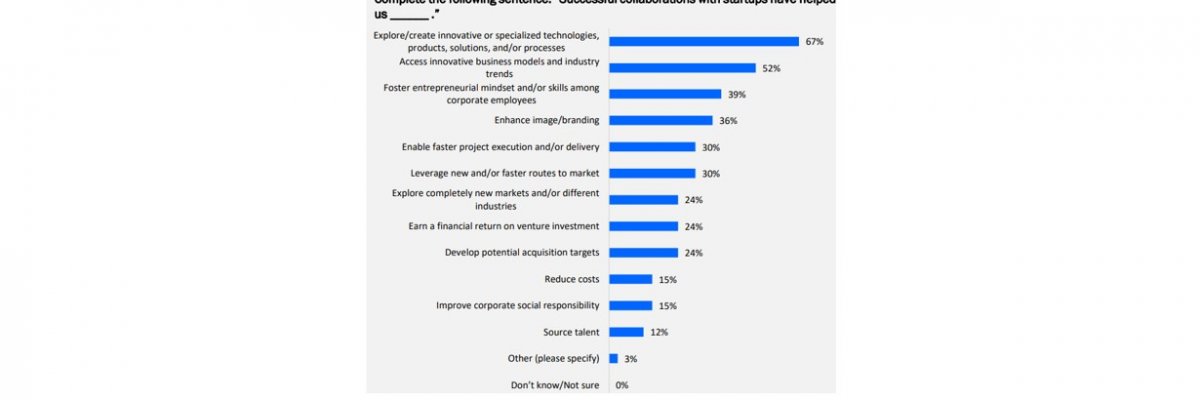
Collaborations between startups and corporates hold risks and benefits for both sides. Thus, a better understanding of corporate-startup collaborations can help both groups to maximize potential benefits while minimizing risks. Reasons for Corporate startup collaboration: “Successful collaborations with startups have helped us ______ .”
Collaborations between startups and corporates hold risks and benefits for both sides. Thus, a better understanding of corporate-startup collaborations can help both groups to maximize potential benefits while minimizing risks.
A primary concern in corporate startup collaboration is that corporations in their partnership with startups are often fail due to internal matters. One difficulty is risk aversion and, in many organizations, the chance that a project may fail is considered as something that should be avoided from the outset. It is insufficient to create a dedicated innovation team. The company as a whole must be committed in order to change the business, launch new products, and create new business models. As a result, when working with startups, the organization as a whole must be in alignment.
Oxford Research studied the collaborations between startups and corporates with corporates from the Nordics (45 companies from Denmark, Finland, Iceland, Norway and Sweden). The study showed that 78 % of the Nordic corporates are collaborating with startups. Most Nordic corporates engage in collaborations with startups, since it allows them to explore/create new innovative technologies and solutions, access innovative business models and industry trends, and to foster a more entrepreneurial mindset among their employees.
The vast majority of the Nordic corporates (91 %) engage in ‘Pilot and Partnerships’ with the startups meaning that the collaboration is often centered around co-development and/or procurement of solutions. So the Nordic corporates’ engagement with startups is often centered around co-development.
So why do Nordic corporates collaborate with startups? This is shown in the figure, where corporates were asked to complete the following sentence: “Successful collaborations with startups have helped us ______ .”
It can be seen that the motivation for engaging in collaboration with the startups is mainly to increase the companies’ innovation potential, and the survey shows that the collaborations with the startups have helped many corporates to either explore/create innovative or specialized technologies, products, solutions and/or processes (67 %) or access innovative business models and industry trends. (52 %). Other key results from collaboration with startups include fostering an entrepreneurial mindset and/or skills among corporate employees (39 %) and enhancing the image/branding of the corporate (36 %).
Identifying startup partners
To find the perfect startup partners, corporations should adopt a strategic approach. It is crucial for big organizations to have a systematic method to approach innovation partnerships and not entirely rely on startup inquiries. However, many companies still use highly inefficient tools to track them, resulting in poor outcomes and too many options.
In the world of corporate-startup collaboration an important element is startup scouting strategies, i.e. how to create a first step in collaboration.
One approach is implementing strategies to attract potential partners to your business (i.e. corporation itself approaches and/or scouts startups) using methods like search engine optimization, social media marketing, and generally building a strong online presence. This method has the advantage that it attracts higher-quality leads who are actively interested in your offerings and it can lead to a steady stream of organic traffic and brand loyalty. This method was used by 67% of the corporates.
But there are also disadvantages that inflow is limited to those who are actively seeking information or solutions and can take time to build momentum. Additionally, these inbound strategies might not always capture the attention of the most desirable, high-value prospects, as they may not be actively searching or might be more elusive.
Competitions and events such as hackathons and/or entrepreneurship events was used by 52%., where corporates can engage the startup ecosystem around a particular theme and put the call out for startups.
Yet another approach is to cast a wide net and make your presence known to as many people as possible, in the hope of capturing the attention of those who might be interested in your innovation project (i.e. selecting from a subset of startups that approach the corporation). This method was used by 48% of corporates. By implementing outbound startup scouting, innovation managers experience benefits such as having more control over who you target and when you reach out to them and these efforts can yield faster results in terms of candidates and how the collaborative journey develops over time.
Another more costly way is to set up a corporate accelerator program (30 %) pairing domain expertise and resources, of a corporate together with a startup, in order to leverage their respective strengths to grow the startup.
Novable adds to these methods the concept of using an AI powered tool for finding suitable startups, similar to Klever to build effective innovation ecosystems. Klever adds to this the concept of Collective Tech partnerships between corporates to collectively build knowledge and partnerships in the Netherlands and in the Nordics on specific themes.